9,767 votes, 18 states: Connecticut (374 / 0.31%), Illinois (249 / 0.04%), Indiana (37 / 0.01), Iowa (110 / 0.09%), Kentucky (818 / 0.31%), Maryland (10 / 0.01%), Massachusetts (84 / 0.03%), Michigan (767 / 0.24%), Minnesota (144 / 0.12%), Missouri (64 / 0.02%), Nebraska (1,624 / 2.99%), New Hampshire (75 / 0.09%), New Jersey (43 / 0.02%), New York (2,359 / 0.23%), Ohio (1,636 / 0.25%), Pennsylvania (1,318 / 0.17%), Rhode Island (60 / 0.23%), Wisconsin (27 / 0.01%)
(United brethren)
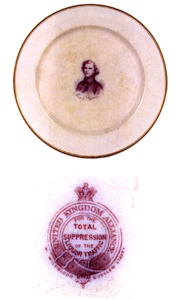 |
Rare China Dinner Plate Picturing 1880 Prohibition Party Candidate Neal Dow. From a huge service custom made for presentation to Dow in the 1880's. Most pieces remain in his Maine Mansion, now a historical site, but a few have been "liberated" over the years and are now owned by collectors. |
|
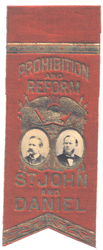
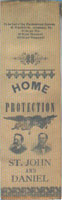
D.I. Herdon, in his "Centennial History of Arkansas" (1922, p.331) says that there was an "American Prohibition Party" faction at the 1884 convention which nominated Samuel C. Pomeroy of Kansas and John A. Conant of Connecticutt. Storms does not mention this, and the Pomery/Conant vote total is not known.
249,945 reported votes from 37 states: Alabama 583 (0.33%), Arkansas 615 (0.39%), California 5,761 (2.3%), Colorado 2,192 (2.39%), Connecticut 4,236 (2.75%), Delaware 400 (1.34%), Florida 418 (0.63%), Georgia 1,808 (1.26%), Illinois 21,703 (2.90%), Indiana 9,881 (1.84%), Iowa 3,550 (0.88%), Kansas 6,779 (2.05%), Kentucky 5,225 (1.52%), Louisiana 160 (0.14%), Maine 2,691 (2.10%), Maryland 4,767 (2.26%), Massachusetts 8,701 (2.53%), Michigan 20,945 (4.41%), Minnesota 15,311 (5.82%), Mississippi 258 (0.22%), Missouri 4,539 (0.87%), Nebraska 9,429 (4.65%), Nevada 41 (0.32%), New Hampshire 1,593 (1.75%), New Jersey 7,933 (2.61%), New York 30,231 (2.29%), North Carolina 2,789 (0.98%), Ohio 24,356 (2.90%), Oregon 1,677 (2.71%), Pennsylvania 20,966 (2.10%), Rhode Island 1,251 (3.07%), Tennessee 5,975 (1.96%), Texas 4,749 (1.33%), Vermont 1,460 (2.30%), Virginia 1,682 (0.55%), West Virginia 1,085 (0.68%), Wisconsin 14,413 (4.06%)
 |  |  |  |
|---|---|---|---|
| |||
 |
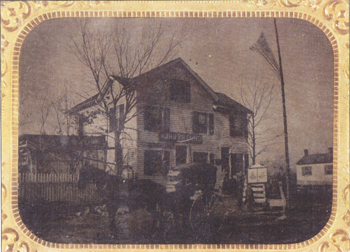 Missouri State headquarters in St. Louis, 1888 |
||
|
|||
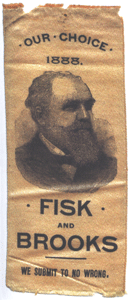
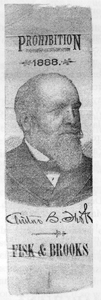
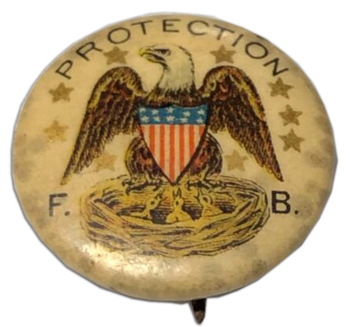
This "F B" item, which sometimes is represented to be from the Fisk & Brooks campaign, is more recent and was issued by a "Fraternal Brotherhood" club in Berkeley, California. |
|||
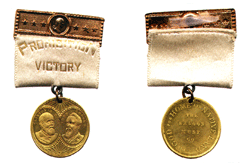
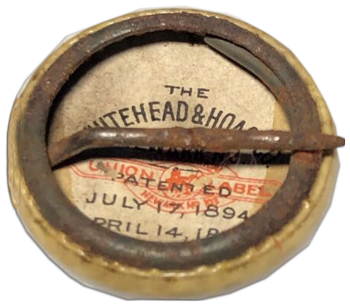
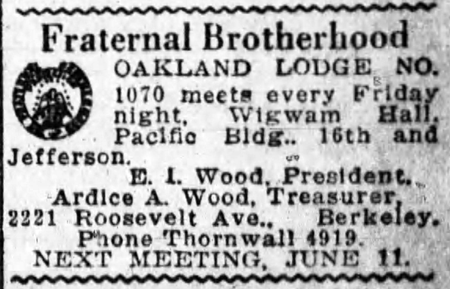
271,058 reported votes, 41 states: Alabama 241 (0.10%), Arkansas 130 (0.09%), California 8,096 (3.00%), Colorado 1,687 (1.80%), Connecticut 4,026 (2.45%), Delaware 514 (1.51%), Florida 570 (1.60%), Georgia 988 (0.45%), Idaho 288 (1.47%), Illinois 25,870 (2.96%), Indiana 13,050 (2.36%), Iowa 6,402 (1.44%), Kansas 4,533 (1.40%), Kentucky 6,442 (1.89%), Maine 3,062 (2.63%), Maryland 5,877 (2.76%), Massachusetts 7,539 (1.93%), Michigan 20,857 (4.48%), Minnesota 14,182 (5.31%), Mississippi 995 (1.89%), Missouri 4,331 (0.80%), Montana 549 (1.24%), Nebraska 4,902 (2.34%), Nevada 89 (0.82%), New Hampshire 1,297 (1.45%), New Jersey 8,134 (2.41%), New York 38,193 (2.86%), North Carolina 2,630 (0.94%), North Dakota 899 (2.49%), Ohio 26,012 (3.06%), Oregon 2,281 (2.91%), Pennsylvania 25,123 (2.50%), Rhode Island 1,654 (3.11%), Tennessee 4,851 (1.81%), Texas 2,165 (0.51%), Vermont 1,424 (2.55%), Virginia 2,798 (0.96%), Washington 2,553 (2.31%), West Virginia 2,145 (2.21%), Wisconsin 13,132 (3.54%), Wyoming 530 (3.17%)
** the record vote and percentage for the Prohibition Party (2.3%)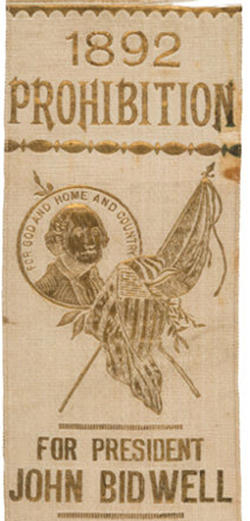 |
 |
|
 |
 |
 |
 |
|
 |
|
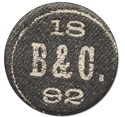
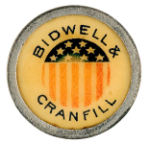
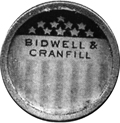
130,617 reported votes [plus 13,969 for the National Party faction], 41 states: Alabama 2,147 (1.10%), Arkansas 889 (0.60%), California 2,573 (0.86%), Colorado 1,724 (0.91%), Connecticut 1,806 (1.04%), Delaware 602 (1.56%), Florida 654 (1.41%), Georgia 5,613 (3.44%), Idaho 181 (0.61%), Illinois 9,818 (0.90%), Indiana 3,056 (0.48%), Iowa 3,192 (0.61%), Kansas 1,721 (0.51%”), Kentucky 4,781 (1.07%), Maine 1,589 (1.34), Maryland 5,982 (2.36), Massachusetts 3,060 (0.76%), Michigan 5,025 (0.92%), Minnesota 4,348 (1.27%), Mississippi 485 (0.69%}), Missouri 2,169 (0.32%), Montana 186 (0.35%), Nebraska 1,243 (0.55), New Hampshire 776, (0.93%), New Jersey 5,617 (1.51%), New York 16,086 (1.13%), North Carolina 681 (0.21%), North Dakota 358 (0.76%), Ohio 5,084 (0.50%), Oregon 919 (0.94%), Pennsylvania 19,274 (1.61%), Rhode Island 1,161 (2.12%), South Dakota 683 (0.82%), Tennessee 3,140 (0.97%), Texas 1,786 (0.33), Vermont 733 (1.15%), Virginia 2,344 (0.72%), Washington 968 (1.03%), West Virginia 1,223 (0.61%), Wisconsin 7,509 (1.68%), Wyoming 159 (0.77%)
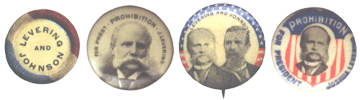

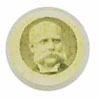

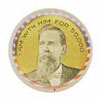
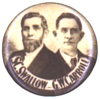
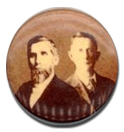
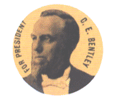 | Left: Charles E. Bentley was the Free-Silver Prohibitionists presidential candidate in 1896. Bentley's vice-presidential running mate was James H. Southgate. |
The Free-Silver Prohibition Candidates, Bentley and Southgate, ran in some of the same states as did the official Johnson & Levering ticket using the name "National Party." | |
Printed, celluloid-covered, "cello," lapel pins such as these became popular in the campaign of 1896. Most earlier campaign portrait buttons were made by fastening actual photographs on metal or cardboard onto a pin or stud. The stamped metal images, "medals," commonly used in pre-1896 campaigns were largely discontinued after the 1890s.
Halftone printing, developed around 1890, quickly replaced photographs on campaign items.
209,469 reported votes: Alabama (3796 / 2.37%), Arkansas (584 / 0.46%),California (5087 / 1.68%), Colorado (3790 / 1.71%), Connecticut (1617 / 0.90%), Delaware (546 / 1.30%), Florida (2234 / 5.67%), Georgia (1396 / 1.14%), Idaho (857 / 1.49%), Illinois (17,626 / 1.56%), Indiana (13,718 / 2.07%), Iowa (9502 / 1.79%), Kansas (3605 / 1.02%), Kentucky (2814 / 0.60%), Maine (2585 / 2.45%), Maryland (4575 / 1.73%), Massachusetts (6208 / 1.50%), Michigan (11,859 / 2.18%), Minnesota (8555 / 2.10%), Missouri (5965 / 0.87%), Montana (298 / 0.47), Nebraska (3655 / 1.51%), New Hampshire (1271 / 1.38%), New Jersey (7190 / 1.79%), New York (22,077 / 1.43%), North Carolina (1009 / 0.34%), North Dakota (735 / 1.27%), Ohio (10,203 / 0.98%), Oregon (2536 / 3.01), Pennsylvania (27,908 / 2.38%), Rhode Island (1529 / 2.70%), South Dakota (1542 / 1.60%), Tennessee (3882 / 1.42%), Texas (2644 / 0.62%), Utah (209 / 0.22%), Vermont (383 / 0.68%), Virginia (2150 / 0.81%), Washington (2363 / 2.20%), West Virginia (1692 / 0.77), Wisconsin (10,022 / 2.26%)
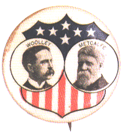
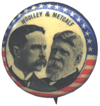
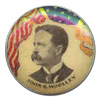
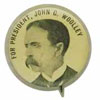
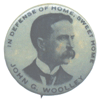
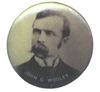
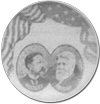
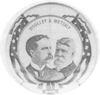
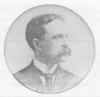
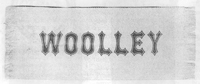

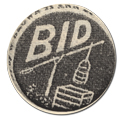
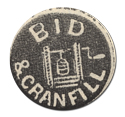
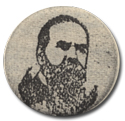
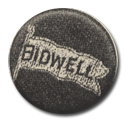
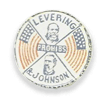
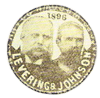
The jugate Wooley & Metcalfe pin at upper left was issued by three other political parties in 1900, substituting only the photographs of their own candidates: (Republicans) McKinley and Roosevelt, (Democrats) bryan and Stevenson, and (Socialists) Debs and Harriman.
The only other election in which at least four parties used an identical design was that of 1912, when the Republicans, Democrats, Socialists, and Bull Moose all issued buttons of the same design. Thanks to Robert Fratkin and The Keynoter for this factoid!
258,205 reported votes from 40 states: Alabama 612 (0.56%), Arkansas 993 (0.85%), California 7380 (2.23%), Colorado 3438 (1.41%), Connecticut 1506 (0.79%), Delaware 607 (1.38%), Florida (write-ins), Georgia 685 (0.52%), Idaho 1013 (1.40%), Illinois 34,770 (3.23%), Indiana 23,496 (3.44%), Iowa 11,601 (2.39%), Kansas 7306 (2.22%), Kentucky 6609 (1.52%), Maine 1510 (1.57%), Maryland 3034 (1.35%), Massachusetts 42386 (0.96%), Michigan 13,441 (2.56%), Minnesota 6253 (2.14%), Missouri 7191 (1.12%), Montana 335 (0.52%), Nebraska 6323 (2.80%), New Hampshire 749 (0.83%), New Jersey 6845 (1.58%), New York 20,787 (1.28%), North Carolina 361 (0.17%), North Dakota 1140 (1.62%), Ohio 19,339 (1.92%), Oregon 3806 (4.22%), Pennsylvania 33,717 (2.73), Rhode Island 768 (1.12%), South Dakota 2965 (2.92%), Tennessee 1906 (0.79%), Texas 4292 (1.71%), Vermont 792 (1.53%), Virginia 1383 (1.06%), Washington 3229 (2.22%), West Virginia 4604 (1.92%), Wisconsin 9770 (2.21%), Wyoming 217 (0.71%).
   |    |
   | |
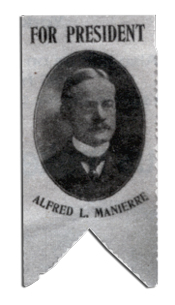 |
Maniere sought the presidential nomination in 1904. |
40 states, 253,231 votes: Alabama (665 / 0.64%), Arkansas (1,194 / 0.78%), California (11,770 / 3.04%), Colorado 5,559 / 2.11%), Connecticut (2,380 / 1.25%), Delaware (670 / 1.40%), Florida (1,356 / 2.75%), Georgia (1,059 /0.80%), Idaho (1,986 / 2.04%), Illinois (29,364 / 2.54%), Indiana (18,045 / 2.50%), Iowa (9,837 / 1.99%), Kansas (5,033 / 1.34%), Kentucky (5,887 / 1.20%), Maine (1,487 / 1.40%), Maryland (3,302 / 1.38%), Massachusetts (4,379 / 0.96%), Michigan (16,094 / 3.13%), Minnesota (11,107 / 3.35%), Missouri (,231 / 0.59%), Montana (827 / 1.20%), Nebraska (5,179 / 1.94%), New Hampshire (05 / 1.01%), New Jersey (4,934 / 1.06%), New York (22,667 / 1.38), North Carolina (360 / 0.14), North Dakota (1,553 / 1.64%), Ohio (11,402 / 1.02%), Oregon (2,682 / 2.42%), Pennsylvania (36,694 / 2.90%), Rhode Island (1,016 / 1.40%), South Dakota (4,039 / 3.52%), Tennessee (300 / 0.12%), Texas (1,634 / 0.56%), Vermont (802 / 1.52%), Virginia (1,111 / 0.81%), Washington (4,700 / 2.55%), West Virginia (5,139 / 1.99%), Wisconsin (11,572 / 2.55%), Wyoming (66 / 0.18%).


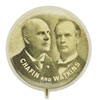
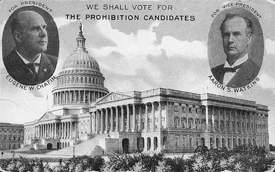 |
|

(Methodist)
40 states, 207,828 votes: Arizona (265 / 1.12%), Arkansas (898 / 0.72%), California (23,366 / 3.47%). Colorado (5,063 / 1.90%), Connecticut (2,068 / 1.09%). Delaware (623 / 1.28%, Florida (1,854 / 3.57%), Georgia (148 / 0.12%), Idaho (1,537 / 1.45%), Illinois (15,710 / 1.37%), Indiana (19,249 / 2.94%), Iowa (9,026 / 1.83%), Kentucky (3,233 / 0.71%), Maine (946 / 0.73%), Maryland (2,244 / 0.97%, Massachusetts (2,799 / 0.57%), Michigan (8,934 / 1.62%), Minnesota (7,866 / 2.36%), Missouri (5,380 / 0.77%), Montana (32 / 0.04%), Nebraska (3,383 / 1.36%), New Hampshire (535 / 0.651%), New Jersey (2,915 / 0.67%), New York (19,427 / 1.22%), North Carolina (128 / 0.05%), North Dakota (1,243 / 1.44%), Oklahoma (2,185 / 0.86%), Ohio(11,511 / 1.11%), Oregon (4,360 / 3.18%), Pennsylvania (19,533 / 1.60%), Rhode Island (616 / 0.79%), South Dakota (3,910 / 3.36%), Tennessee (834 / 0.33%), Texas (1,738 / 0.57%), Vermont (1,095 / 1.74%), Virginia (709 / 0.52%), Washington (9,810 / 3.04%), West Virginia (4,534 / 1.69%), Wisconsin (8,586 / 2.15%), Wyoming (434 / 1.03%).
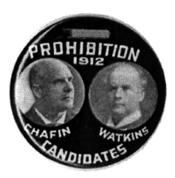


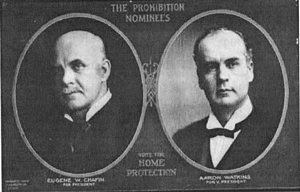
43 states, 221,329 reported votes: Alabama (999/ 0.76%), Arizona (1153/1.99%), Arkansas (2015/1.20%), California (27,713/ 2.77%), Colorado (2793/0.95%), Connecticut (1789/0.84%), Delaware (566/1.09%), Florida (4786/6.01%), Idaho (1127/0.84%), Illinois (26,047/1.19%), Indiana (16,368/2.28%), Iowa (3371/0.65%), Kansas (12,882/2.05%), Kentucky (3036/0.58%), Maine (597/0.44%), Maryland (2903/0.56%), Massachusetts (2993/0.56%), Michigan (8139/1.25%), Minnesota (7793/2.01%), Missouri (3884/0.49%), Nebraska (2952/1.03%), North Carolina (51/0.02%), Nevada (348/1.04%), New Hampshire (308/0.34%), New Jersey (3217/0.65%), New Mexico (112/0.17%), New York (19,031/1.12%), North Dakota (997/0.86%), Ohio (8080/0.69%), Oklahoma (1646/0.56%), Oregon (4729/1.81%), Pennsylvania (28,525/2.20%), Rhode Island (470/0.54%), South Dakota (1774/1.38%), Tennessee (147/0.05%), Texas (1985/0.53%), Utah (149/0.10%), Vermont (709/1.1%), Virginia (683/0.44%), Washington (6868/1.80%), West Virginia (179/0.06%), Wisconsin (7166/1.59%), Wyoming (373/0.72%).

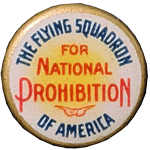
Richard Winger points out (Ballot Access News 24(1):6) that, in 1916, the Landrith/Hanly Prohibition ticket "spoiled" the chances of Republican nominee Charles Evans Hughes and threw the presidential election to Wilson. Winger says "That is the most fascinating example of 'spoiling' in U.S. history. It was the second time the Prohibition Party had tipped a presidential election against the Republicans," the first time having been the defeat of Blaine in 1884.
As a consequence, "Republicans in Congress passed the Constitutional amendment in 1917 to impose nationwide prohibition of alcoholic beverages. The proposal had been introduced in every Congress starting in 1875, but had never come close to passing by the necessary two-thirds majority. But the Republicans, having lost 2 presidential elections to the Prohibition Party, decided to end that problem once and for all, by accepting the amendment and thus killing the rationale for the Prohibition Party to continue to exist."
The Prohibition Party, although it has never came close to winning a national election, nevertheless achieved its primary legislative goal by "spoiling" presidential elections. Never believe that we are "too small to matter."
vice-presidential candidate
57,551 reported votes, 17 states: Alabama (569 / 0.34), California (18,365 / 1.43%), Colorado (966 / 0.28%), Florida (5,498/ 5.04%), Georgia (231 / 0.14%), Illinois (2367 / 0.10%), Indiana (4416 / 0.35%), Michigan (6,085 / 0.52%), Missouri (1,418 / 0.11%), Nebraska (1,594 / 0.34%), New Jersey (1,660 / 0.15%), North Carolina 13 (0+%), Ohio 1,246 (0.06%), Pennsylvania 9,779 (0.46%), Tennessee 100 (0.03%), Vermont 326 (0.32%), Wisconsin 2,918 (0.35%)
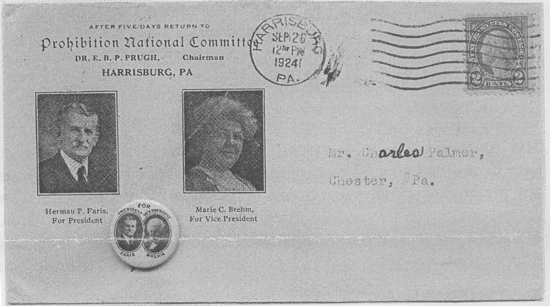
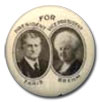 |
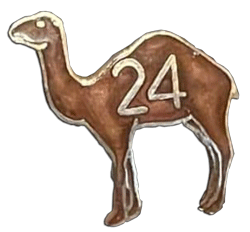
This is similar to the "24-hours sober" pin used as a promotional item by the Alcoholics Anonymous organization and may not be a political item, at all. |
20,106 votes, 8 states: Indiana 5,496 (0.39%), Michigan 2,728 (0.20%), New Jersey 160 (0.01%), Ohio 3,556 (0.14%)”, Pennsylvania 3,880 (0.12%), Vermont 338 (0.25%), West Virginia 1,703 (0.26%”), Wisconsin 2,245 (0.22%)
(Free Methodist)

74,758 reported votes, states (26): Alabama (1095 / 0.45%), Arizona (421 / 0.31%), California (14,770 / 0.42%), Delaware (294 / 0.23%), Florida (27 write-ins), Georgia (36 write-ins), Idaho (503 / 0.24%), Illinois (7411 / 0.18%), Indiana (12,574 / 0.75%), Iowa (3752 / 0.36%), Kansas (2609 / 0.36%), Kentucky (2012 / 0.23%), Massachusetts (973 / 0.05%), Michigan (6503 / 0.29%), Missouri (1175 / 0.07%), Montana (340 / 0.16%), New Jersey (4255 / 0.22%), New Mexico (148 / 0.10%, North Dakota (549 / 0.25%), Oklahoma (1663 / 0.23%), Oregon (2362 / 0.49%), Pennsylvania (5750 / 0.15%), Rhode Island (433 / 0.14%), South Carolina (365 / 0.35%), Tennessee (885 / 0.17%), Texas (1017 / 0.09%), Virginia (459 / 0.12%), Washington (2396 / 0.28%)


41,937 reported votes, 10 states: California 11,119 (0.10%), Delaware 400 (0.22%), Indiana 6,554 (0.33%), Kansas 3,048 (0.35%), Kentucky 3,145 (0.20%), Massachusetts 1205 (0.05%), Michigan 6923 (0.22%), New Jersey 9147 (0.37%), New Mexico (607 / 0.24%), Tennessee (789 (0.08%)
of Evangelicals (Baptist)
46,239 reported votes, 11 states: Alabama 2,106 (0.37%), California 21,706 (0.33%), Delaware 284 (0.14%), Indiana 6,746 (0.32%), Kansas 4,138 (0.45%), Massachusetts 1,633 (0.07%), Michigan 2,029 (0.06%), Montana 456 (0.16%), New Mexico 777 (0.25%), Tennessee 2,475 (0.24%), Texas 3,870 (0.17%)
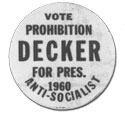
23,267 reported votes, states (9): Colorado (1356 / 0.17%), Delaware (425 / 0.21%), Indiana (8266 / 0.40%), Iowa (1902 / 0.16%), Kansas (5393 / 0.63%), Massachusetts (3735 / 0.16%), Montana (499 / 0.18%), New Mexico (543 / 0.17%), North Dakota (174 / 0.07%); in addition, there were 305 write-ins in California and 669 write-ins in Michigan.
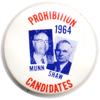
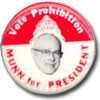
15,063 votes, 12 states: Alabama 4,022 (0.38%), California 59 (0+%), Colorado 275 (0.03%), Indiana 4,616 (0.22%), Iowa 362 (0.03%), Kansas 2,192 (0.25%), Massachusetts 2,369 (0.10%), Michigan 60 (0+%), Montana 510 (0.19%), North Dakota 38 (0.02%), Ohio 19 (0+%)), Virginia 601 (0.04%)
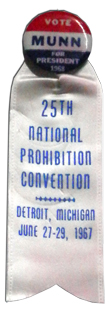
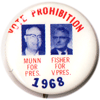
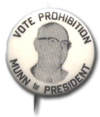
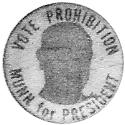
13,598 votes 6 states: Alabama 8,551 (0.85%), California 53 (0+%), Colorado 467 (0.05%), Delaware 238 (0.10%), Kansas 4,188 (0.46%), Tennessee 93 (0.01%)
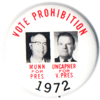
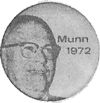
15,839 votes, 13 states: Alabama 6,669 (0.56%), California 31 (0+%), Colorado 2,882 (0.27%), Delaware 103 (0.04%), Kansas 1,403 (0.15%), Maine 3,495 (0.72%), Massachusetts 14 (0+%), Michigan 13 (0+%), New Jersey 554 (0.02%), New Mexico 211 (0.05%), North Dakota 63 (0.02%), Ohio 62 (0+%), Tennessee 442 (0.03%)
 |  |  |  |
|---|---|---|---|
 |
(Baptist)
7237 reported votes, 8 states Alabama (1743 / 0.13%), Arkansas (1350 / 0.16%), California (36 write-ins), Colorado (1180 / 0.10%), Delaware (6 write-ins), Iowa (150 / 0.01%), Kansas (821 / 0.08%), Maine (19 write-ins), Massachusetts (34 write-ins), Michigan (9 write-ins), New Mexico (1281 / 0.28%), North Dakota (54 / 0.02%), Ohio (27 write-ins), Tennessee (521 / 0.03%).
and Pardons (Free Methodist)
(independent Baptist)
208 reported votes, 1 state : Colorado (208 / 0.01%)
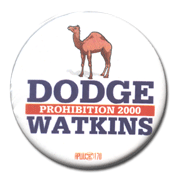
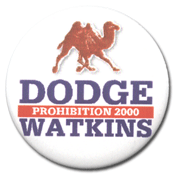
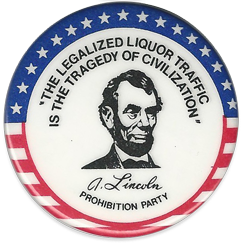
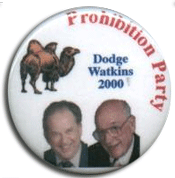
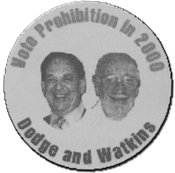
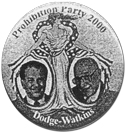
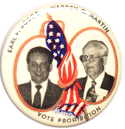
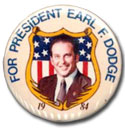
A private, invitational conference of (some) Prohibition National Committeemen, held at the chairman's home in June, 2003, recommended then-chairman Earl F. Dodge for president and Texas national committeeman Howard Lydick for vice-president. These candidacies were explicitly rejected by the 34th quadrennial nominating convention of the Prohibition Party, held at Fairfield Glade, Tennessee in September
.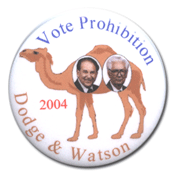
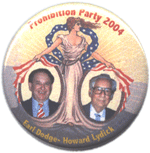
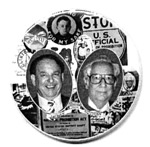
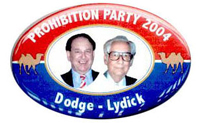
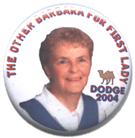
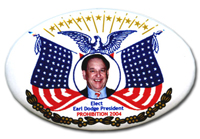
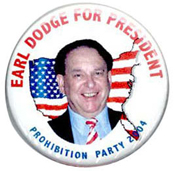
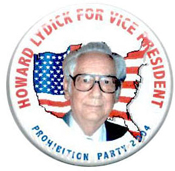
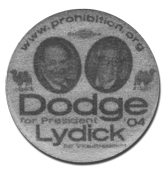
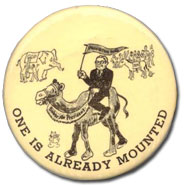
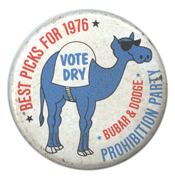
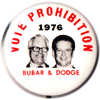
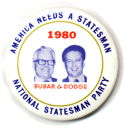
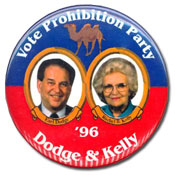
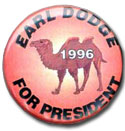
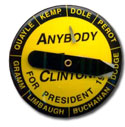
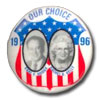
The button at upper left is a vendor button. All others were sold by Dodge or were offered to donors as incentives. It is doubtful that any of Dodge's buttons were given away as campaign items.
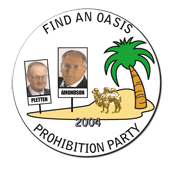
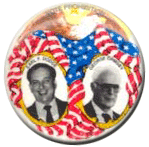
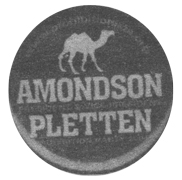 This button appeared in s dealer's catalog in 2013, incorrectly attributed to "hopefulls, Prohibition 2004" Nothing is known of its provenance.
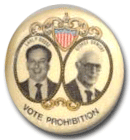
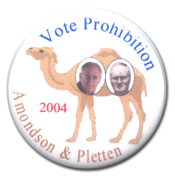
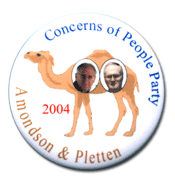
The LH button was issued by the Prohibition National Committee and was distributed during
the campaign; the center and RH buttons are vendor buttons.
Dodge and Lydick, the unendorsed independents in Colorado, received 140 votes, fewer than half as many as the official Prohibition Party ticket. This is an unequivocal repudiation by the voters of Earl F. Dodge as a Prohibition Party spokesman. (Dodge and Lydick failed to get on the ballot in any other state.)
Probably, ballot position had much to do with the large vote in Louisiana: We were at the top of the second column. In Colorado, we were about half way down the column (Dodge & Lydick were five positions below "Concerns of People.")
653 reported votes, 3 states: Colorado (85 / 0%), Florida (293 / 0%), Louisiana (275 / 0.01%).
Neither candidate did any campaigning. These votes probably are entirely "protest" votes and are low because of down-column ballot positions in all 3 states.
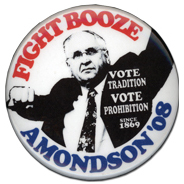
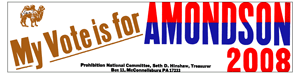
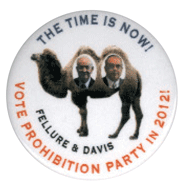
5623 reported votes, states (3): Arkansas 4709, Colorado 185, Mississippi 715, plus write-ins from Pennsylvania 6, Maryland 5, and Kansas 3. .
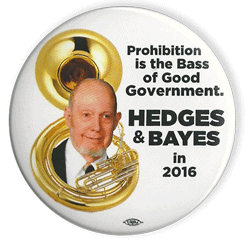
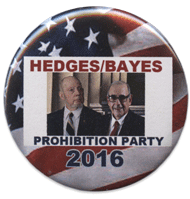
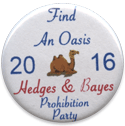
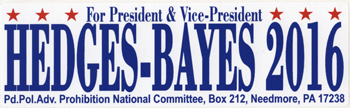
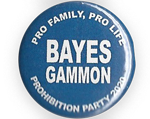
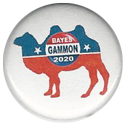
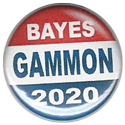
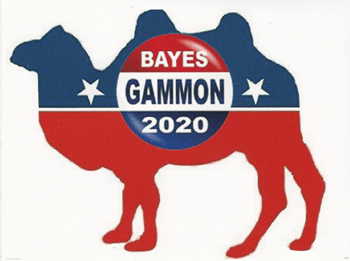
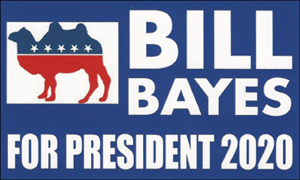
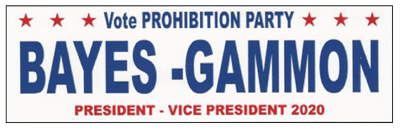
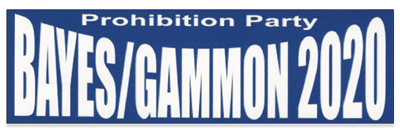
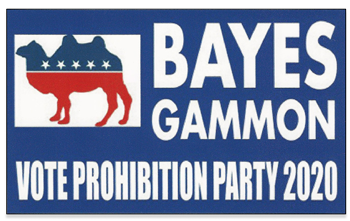
Gammon dropped out, for personal reasons, in 2019. The ticket was revised again:
President -- Phil Collins (IL), Public opinion researcher (Lutheran)
4,834 reported votes. States (4): Arkansas, 2,812 (0.23%); Colorado, 568 (0.02%; Mississippi,
1,317 (0.01%); Vermont, 137 (0.04%)


Campaign memorabilia advertized for sale on campaign website(s) are all "official," in the sense that they are endorsed by and benefit the Prohibition National Committee. However, they are manufactured-to-order and drop-shipped by several different companies, not purchased in bulk and stocked by the National Committee itself.
| Educational Backgrounds of the Candidates
Third-party movements tend to appeal to members of specific cultural, social, or economic subgroups within the larger American population. Some of this data on Prohibition Party leaders is given in the preceding list of candidates. The following table gives their educational backgrounds; where and how long people attend school is one determinant (or reflection) of their philosophical frameworks and value systems. The names are given in their order of nomination (names of vice-presidential candidates are italicized). Some individuals ran more than once, and for both vice-president and for president in different years -- only the first nomination is listed. | |
James Black | Edgar V. Moorman |
The Free-Silver Prohibition candidates, Bentley and Southgate, ran in some of the same states as the "National Party.