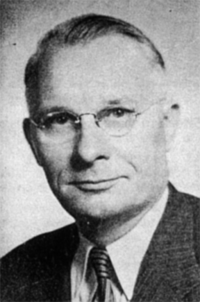
Mark Revell Shaw
Prohibition Party Vice-Presidential candidate in 1964
Mark Shaw was a Prohibition Party candidate for the US Senate from Massachusetts in 1946, 52, 58, 60, 62, 66, and 70. He ran for Governor of Massachusetts in 1948 and again in 1956. In addition to running for Vice-President in 1964, he was nominated for President at our 1972 national convention, but was defeated for the nomination by Harold Munn.
The following biographical comments are mostly taken from the 1978 minutes of the Southern New England Conference of the United Methodist Church; his statement on "confusionism" was published in the June-July, 1963 issue of The National Statesman. Shaw was the other notable Pacifist leader in the Prohibition Party (contemporaneously with 1953-55 national chairman Lowell Coate).
Mark's strong Christian commitment led him to be very active in the Temperance Movement, also. He was nominated and ran for Vice-President of The United States in 1964, under the Prohibition Party banner. As a missionary to Japan for five years. he was primarily concerned with temperance in that country. In the last years of his life, he was Associate Pastor of the Cliftondale Methodist Church and Chairman of the Massachusetts Prohibition Committee.
Mark's father was a traveling evangelist, and his mother was a lecturer for the Woman's Christian Temperance Union. His education and training culminated when he was admitted into membership of the former New England Conference as an elder in 1931.
"He was always heckled when he spoke, because of his strong Pacifist views, but never did he return an attack. Rather, with patient understanding, he listened to critics, and answered them with Christian love," according to Flora Beth Grout, his niece.
In 1938, he became a member of the National Council for the Prevention of War. In 1941, he became pastor of Memorial Methodist Episcopal Church, in Beverly, and, also, secretary of the National Council for the Prevention of War. In 1955, he became editor of "Peace Action" and concurrently served as Northeast Secretary of Democracy Unlimited. He retired in 1961. In 1960, a high point came when he traveled with Jerome Davis to Russia as part of the World Peace Movement.
Mark's strong Christian commitment led him to be very active in the Temperance Movement, also. He was nominated and ran for Vice-President of The United States in 1964, under the Prohibition Party banner.. As a missionary to Japan for five years. he was primarily concerned with temperance in that country.
An international concern for peace and temperance made Mark a political expert not only in The United States but, also, in other governments of the world. He had a network of colleagues and friends about the world who shared his concerns.
After a few months of physical deterioration but mental alertness, Mark and his wife Alma travelled to the home of their son, Professor Mark S. Shaw, in College Park, Pennsylvania. One week later, he died on June 4, 1978.
Confusionism, which so permeates our social order and threatens our body politic, seems daily to be more confounded. Take, for example, the case of Senator Goldwater. For years, he has been crusading against the Communists, at home and abroad. He has been so concerned that he talks of sending the Marines to Cuba and of using atomic weapons in Viet Nam. Few, whether or not they agree with his ideas, doubt his sincerity. Yet, who is doing more to aid the Communists that he because he seems unable, or unwilling, to see things in perspective?
Think of the hundreds of millions of underprivileged, poverty-stricken people among the colored races in Africa, Latin America, and Asia, many of whose parents suffered at the hands of White imperialism and colonialism. Today, they struggle to be free, to gain a new sense of dignity and equality, so long denied them.
In the contest between democracy and communism for the minds of these millions, what greater boon could be given to the thousands of communist propagandists seeking for converts in Africa and Asia than for the news to be flashed around the world next November that Barry Goldwater, after he had voted against the Civil Rights Act, had been elected President by the people of The United States?
Roger Storms, writing in the August, 1978 issue of The National Statesman, said of Shaw:
Shortly after Mark Shaw was nominated for Vice President of the United States, a Maryland woman wrote to him on a postcard: "Do you really think that Prohibition is something that can stir support from the American people in this election? I don't." To this he replied: "Neither do I. But, I think it ought to, and that makes all the difference."
That was my first big lesson from Mark Shaw, and I have always remembered it. I was inspired by his life to strive for what ought to be. There are always lots of people around who will tell you what is. There are always lots of people who will go along with what is. But it is such a rare and precious gift to have a man among us who will strive for what ought to be.
In the days when the Methodist Church adopted resolutions and policies regularly endorsing the Prohibition Party, his Methodist family was in the Party's work. When he was 3 years old, living on the family farm on Michigan's upper peninsula, his mother sent him out with his two older brothers to cut down a spruce pole. She had sewed together a campaign flag for the 1892 national nominees -- Bidwell and Cranfill -- and she flew the flag with pride in her front yard. Shortly before she died, many years later, she had returned home exhausted from a WCTU speaking tour across Michigan, seeking to prevent the Repeal effort there.
Mark Shaw was a leader in the Intercollegiate Prohibition Association during the years when it was the second-largest college youth movement in the country. He was an old-time pacifist and [a] passionate crusader for world peace. His work for the Fellowship of Reconcilliation carried him all over the world. It carried him to Japan before World War II and to the Soviet Union before the Viet Nam war. He was always striving for what ought to be.
But during a long career as a Methodist pastor and peace crusader, he always displayed a paramount devotion to the Prohibition Party. He served for so many years as state chairman of the Party in Massachusetts, always graciously accepting the call to run for any political office and to campaign for the Party's causes. He served on the Prohibition National Committee for as long as anyone in the Party's history. And, it was a special honor to him to have his name placed on the national ticket -- a ticket that he had once gazed at curiously through the eyes of a 3-year old on his mother's flag long ago.
I shall miss Mark Shaw, and I shall always treasure his faithful example. He was courtly, scholarly, and well-reasoned in all that he said and did. And, he gave us all a legacy of what ought to be.