Outline of History
Click here for information about the Partisan Prohibition Historical Society
For an overview of the social milieu out of which the Prohibition Party evolved, see:
McGerr, Michael () -- A Fierce Discontent: The Rise and Fall of the Progressive Movement in America, 1870-1920: Free Press, 395pp.
Hofstadter, Richard and Robert Weibe (1955) -- The Age of Reform
Hofstadter, Richard and Robert Weibe (1967) -- The Search for Order
For an overview of third parties in The United States, including the Prohibition Party, refer to this Random Bibliography:
The standard work on the history of the Prohibition Party is Roger Storms' "Partisan Prophets," published in 1972. Storms died in 1980, of complications from injuries sustained in a traffic accident. No one has collected Party records since 1972, although much information
has been preserved in the monthly issues of the Prohibition Party newsletter,
"The National Statesman." A stash of Partisan Prophets was recently discovered, and single copies are now available on request from the Prohibition National Committee, Box ll, McConnellsburg, Pennsylvania 17233.
Storms' work is not error-free, unfortunately. When Storms and this
website contradict each other, this website is more likely to be correct.
Please notify the editor
of any additional mistakes in Storms.
Prohibition Party presidential candidates polled over 100,000 votes at
each election from 1884 to 1920. The Prohibition Party elected Sidney
Catts governor of Florida in 1916. It elected Kittel Halvorson of Minnesota
to Congress in 1890, and it elected Charles Randall of California to Congress
for three terms (1914 - 1916 - 1918). In 1904, it elected 204 local
officials in just one county, Venango County, in Pennsylvania.
The Prohibition Party candidate who received the highest vote total in
a single election was Rev. Robert P. Shuler in a 1932 California race
for the US Senate. He garnered 560,088 votes (25.8%) and carried Orange
and Riverside counties. He had previously played a key role in exposing
corruption in other states. He was one of those involved in the investigation
which led to the ouster of Gov. Ferguson in Texas.
The last Prohibition Party members to win election to office in the 20th Century were three local officials in the town of Lee, ME in 1978. Fred Dingley won re-election as town moderator, for a total of 30 years of service in that office. Roger Storms was re-elected to the District 30 School Board, and his wife Margaret was re-elected as town clerk.
These people were elected as non-partisan candidates (no party label on ballot), although they were Prohibition Party members. The last Prohibition Party candidates elected in the 20th Century were two members of the Winona Lake, Indiana town council, in 1959.
The first Prohibition Party candidate to be elected in the 21st Century was James Hedges, township assessor in Thompson Township, Fulton County, Pennsylvania. Hedges was elected in 2001, for a 4-year term. He was re-elected in 2005, after which the state legislature abolished the office of "Township Assessor." (Incumbents were allowed to complete their terms.)
Prohibition National Committee Chairmen
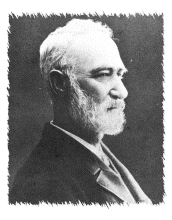
First Chairman of the Prohibition National Committee
John Russell of Michigan (1867- 1872)
|
1867-1872 |
John Russell, Michigan |
|
1872-1876 |
Simeon B. Chase, Pennsylvania |
|
1876-1880 |
James Black, Pennsylvania |
|
1880-1884 |
Gideon T. Stewart, Ohio |
|
1884-1887 |
John B. Finch, Nebraska |
|
1887-1900 |
Samuel Dickie, Michigan |
|
1900-1905 |
Oliver W. Stewart, Illinois |
|
1905-1908 |
Charles R. Jones, Pennsylvania |
|
1908-1924 |
Virgil G. Hinshaw, Oregon |
|
1924-1925 |
B.E.P. Prugh, Pennsylvania |
|
1925-1932 |
D. Leigh Colvin, New York |
|
1932-1947 |
Edward E. Blake, Illinois |
|
1947-1950 |
Virgil C. Finnell, Indiana |
|
1950-1953 |
Gerald Overholt, Texas |
|
1953-1955 |
Lowell H. Coate, California |
|
1955-1971 |
E. Harold Munn, Sr., Michigan |
1958-1962(c) |
Earl F.
Dodge, Massachusetts Delmar D. Gibbons, Michigan |
|
1971-1979 |
Charles Wesley Ewing, Michigan |
|
1979-2003 |
Earl F. Dodge, Colorado |
| 2003-2005 | Don Webb, Alabama |
| 2005-2009 |
Gene Amondson, Alaska |
| 2009-2013 | Toby Davis, Tennessee |
| 2013-2014 | Gregory Seltzer, Maryland |
| 2014-2019 | Rick Knox, Georgia |
| 2019- 2020 | Randy McNutt, Ohio |
| 2020-2023 | Phil Collins, Wisconsin |
| 2023- | Zack Kusnir, New York |
Between 1933 and 2003, the chairman of the National Committee served as editor of the National Committee's newsletter, The National Statesman. The Statesman was founded by then national chairman Edward Blake in 1933. It was discontinued in 2003.
A separate office of 'Executive Secretary' was established in 1955, when E. Harold Munn became chairman. Former chairman Virgil C. Finnell was named to the position. Future chairman Earl F. Dodge held the position from 1957 through 1963. Dodge was followed by Delmar D. Gibbons, 1963-1967. Dodge then returned and served from 1968 until 1979, at which time the positions of chairman and executive secretary were merged. The position of Executive Secretary was separated from that of chairman in 2003.
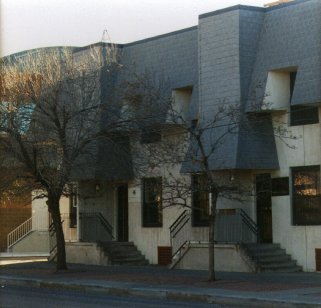
photo by Earl Higgerson, 1997
Condo unit at left is the "Russell Building," 128 West 11th Ave, Denver, Colorado, the National headquarters of the Prohibition Party, 1977-1999. Since 1999, the national office has been in Earl Dodge's house near Denver and then in Jim Hedges' house in Fulton County, Pennsylvania. Earlier national offices were in Chicago (1933-1947), in Winona Lake ("The Cottage")(1962-1963), in St. Louis (1963-1968), in Kalamazoo, and sometimes in Earl Dodge's houses here-n-there.
National Chairman Randy McNutt resigned early in March of 2020, saying that he felt unwell and could not give the Party the energy and drive which it needs.
There have been several official and unofficial periodicals associated with the Prohibition Party. There was "The Voice" in New York, "The New Voice" also in New York, "The Lever" in Chicago, "The Vindicator" in Pennsylvania, a "National Prohibitionist" in Chicago and Winona Lake, and "The National Statesman" which moved from place to place ending in Denver.
The list of editors which follows is for the National Prohibitionist started in Chicago, later renamed the National Statesman. The National Statesman was disassociated with the Prohibition National Committee in 2003, but continued to be published by former Chairman Earl F. Dodge as his personal journal of opinion until his death in 2007.
National Statesman editors
|
1933-47 — Edward E. Blake (founder), Chicago, Illinois The National Statesman was a member of the Evangelical Press Association in 1968. |
Prohibition Party National Convention Sites |
|
|
|||||||||
1869—CHICAGO, Illinois (founding) |
1977 conference—SANTA ANA, California |
||||||||
|
Earl Dodge's son, Calvin, is said to have a video of the 1987 convention; it is not available for study. |
|||||||||
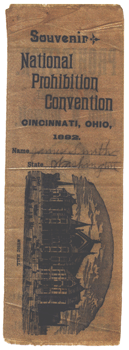
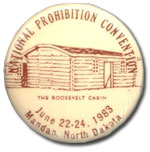
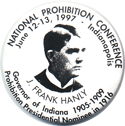

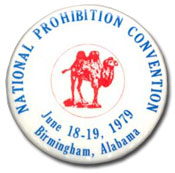
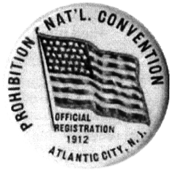
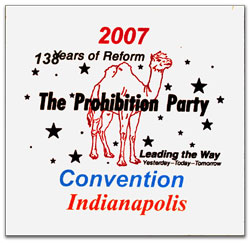
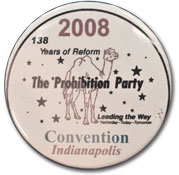

The Storms Collection
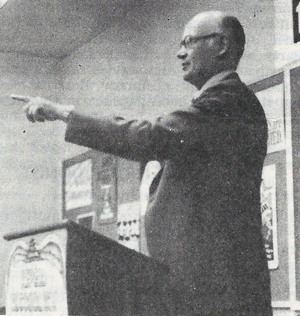
Photo taken in 1979.
The Storms Collection of lapel buttons and other campaign artifacts was begun in 1968, on the initiative of Earl Dodge, and was dedicated to Storms in October, 1981, after Storms' untimely death. It was being stored by Earl Dodge at his home in Lakewood, Colorado at the time of his (Dodge's) death.
Dodge's relatives proceeded to donate most of the material to the Smithsonian Institution, where it is now available for study by appointment. Items rejected by The Smithsonian were sold by the Dodges, who kept the money received.
Bullmoose Chapter of APIC
The Third Party Chapter of the American
Political Items Collectors (APIC) specializes in the history of
third-party movements in America through the dissemination of knowledge
about these parties, their positions on political issues, their history,
their leadership, and their political items. The Chapter illuminates
the place of third parties on the American political landscape. It publishes
a newsletter 4 times each year to keep its members abreast of developments
in third parties in America. The newsletter also includes articles on
the histories of these parties, many of which are written by college
and university faculty members whose areas of specialization are in
this part of American History.
Prohibition Party on TV
The first, and to date only, Prohibition Party candidate to use
paid television advertising in his campaign was David Livingston. Livingston
ran for several Colorado offices in the1980's, ending with a try for
Governor in 1990 and a try for Lt. Governor in 1994. He had two 30-second
spots taped by his local television station to use during his campaign
for Governor. The spots cost $260 to produce and about $800 to broadcast
several times during the early morning hours. They ran on four stations.
Below are Links to both of the two 30-second clips, in "real video"
format. The audio has been fixed. You need to download the  to view the videos.
Video One
Video Two

|

|

|
- Click here for the Partisan Prohibition Historical Society awards listing
- Click here
for the Prohibition Party presidential/vice-presidential candidates
1872 - present - Click here for other Prohibition Party Election returns
- Click here for the Prohibition Party Archive at Ann Arbor, Michigan
- Click here for the Prohibition Party Archive at Columbus, Ohio
- Click here to view a list of public fountains erected by temperance groups.
A third major Prohibition Party collection is held by the WCTU Library at Evanston, Illinois. We have invited them to send us a listing, but we have not yet received a response.
The New York (City) Public Library holds about 4000 volumes on temperance subjects. They have a special interest in Prohibition Party materials. About 450 periodical titles are held; 15 are currently received. There is WCTU material, the James Black temperance collection, the Mary Hannah Hunt correspondence, the Gerrit Smith (family) collection, and the Cyrus Williams papers.
David Fahey notes that some of the items will be difficult for library staff to locate and that much of the ephemera is in poor physical condition.
A collection of temperance material (not necessarily of Prohibition Party material) is included in the Hay Library at Brown University, Providence, Rhode Island. It is described as "a large and interesting collection of temperance material from both the nineteenth and twentieth centuries, including extensive runs of some temperance newspapers."
Trajectory of the Prohibition Party
In the May, 2001 issue of Ballot Access News, Richard Winger presents (p.2, col. 1) an overview of third-party activity, showing when voter interest in alternative politics was relatively high and when it was lower. From 1916, the alternative vote was high. It declined during the late 1920s, rose during the early Depression years, fell, then rose again during the 1940s. Third-party interest was weak 1952-64 (the post-war prosperity interval of the Eisenhower, Kennedy, and Johnson presidencies), rose during the subsequent Viet Nam quagmire, and stayed high through 1982. It then declined once more throughout the 1980s (the Carter and Bush, Sr. era of bi-partisan moderation.) The third-party vote rose sharply in the early 1990s, fell in 1994, then began a long rise to the present day as major-party posturing and intransigence came to overshadow the business of governing in Congress and in the state legislatures.
The Prohibition vote generally fluctuated in phase with this broader measure of voter interest. There was an initial burst of reformist enthusiasm 1869-1892, after which our vote fell slightly to 1916. The 1920s were a period of decline, both for Prohibition specifically and for minor parties generally. Attributing this loss of Prohibition Party momentum to the previous adoption of the 18th Amendment is unwarranted: It was part of a broader political trend.
The Prohibition vote rose in the early 1930s, in parallel with the vote for other minor parties, and fell as the others fell in the later 1930s. It rose during WWII, declined in the 1950s, levelled off around 1970, then fell precipitously during the 1980s and 1990s.
The years of Prohibition decline after 1976 went against the more general trend of third-party voting, for the first time, and they coincide with the Earl Dodge years of poor management.
Prohibition Party fortunes have risen slightly since Dodge’s death, due mostly to collegial management instead of authoritarian direction. The up-tick in 2006 was due to a windfall of escrowed money following resolution of Dodge’s lawsuit against the new officers, which enabled the Party to petition for ballot access in a larger number of states.
Our high-profile winners were mostly flukes: Susanna Salter, the first woman elected mayor of any U.S. city, was the victim of a practical joke, although she accepted her office in Argonia, Kansas after being elected and did a creditable job in it. Sydney Catts, governor of Florida, was a Democrat sore-loser who took revenge on his primary opponent by changing parties and defeating him in the subsequent general election. Minnesota congressman Kittel Halvorsen was a peripatetic who flitted among several parties and won as a fusion candidate. Three-term California congressman Charles Randall was twice a fusion candidate, winning solely as the Prohibition candidate only for his third term.
Earl Dodge claimed without evidence that Prohibition elected “hundreds” of local officials. Data available to the Author suggest that there were perhaps a few dozen, mostly in Jewell County (Kansas), Darke County (Ohio), and Venango County (Pennsylvania).
Geography of the Prohibition Party
The Prohibition Party began as a Progressive organization, based in the Northeast. This is shown by the order in which the states began running state/local candidates: Maine, Minnesota, and Ohio in 1869, followed by Illinois, Massachusetts, Michigan, New Hampshire, and New York in 1870. In today’s terms, these are mostly “blue” (liberal) states.
Pennsylvania got going in 1871, Connecticut in in 1872, Kansas and Nebraska in 1874.
Then the west-coast states came in, California and Oregon both in 1875, plus Iowa, Rhode Island, and Wisconsin. (Washington for some reason did not get organized until 1886, nor did Indiana and Vermont.
That includes all of the West Coast, all of the Upper Midwest, and all of New England.
By contrast, the Deep South, “Dixiecrat,” states had no state or local candidates until 1900 (Alabama), followed by Florida (1916), and Georgia (1932). South Carolina, Mississippi, and Louisiana never had any state or local candidates. This, despite the dominance in Dixie of the (dry) Baptist Church.
Was it the color-blind policy of the Prohibition Party which prevented it from attracting Southerners, or was it the fact that, in its early days, it advocated many other Progressive ideas in addition to racial equality?
The strongest Prohibition states were also states where Mennonite and Brethren churches were strong – western New York and Pennsylvania west through the Corn Belt and the Upper Midwest. Those are, historically, German denominations.
Ironically, those states are also the areas where German immigrants predominated. Did the cultural clash of beer-loving (German) Lutherans and Roman Catholics with abstinent (German) Mennonites and Brethren have something to do with the origin of the Prohibition Party?
Utah is another state with a strong religious bias against drinking, but the Prohibition Party never got a solid grip there. Hardly anyone in Utah is of German ancestry. It appears that, absent a cultural clash, Prohibition politics cannot flourish.